
How the 2025 Mid-South Drought Devastated Honeybee Colonies — And What to Watch for This Year
The summer of 2025 was brutal across the Mid-South. Tennessee recorded its driest July and August in 30 years. The Mississippi River hit near-record low levels. Farmers watched crops wilt. And honeybee colonies, quietly and largely out of public view, began to collapse.
Drought is one of the least-discussed threats to honeybee health, but its effects are severe and cascading. Understanding what happened in 2025 helps explain why swarm activity has been unusually high in early 2026 — and why some of the colonies showing up in Memphis homes right now are in worse shape than typical.
How Drought Starves Bee Colonies
Honeybees depend entirely on flowering plants for food. Nectar provides carbohydrates — the fuel that powers flight, thermoregulation, and colony activity. Pollen provides protein and fat — the nutrients that feed developing larvae and allow nurse bees to produce royal jelly and brood food.
When drought hits, plants respond by shutting down nectar production. It's a survival mechanism: producing nectar costs water and energy the plant doesn't have. From a bee's perspective, the flowers are still there — but the food is gone. Forager bees fly longer distances, burn more energy, and return with less. Colonies that should be building winter stores are instead burning through existing reserves just to survive the summer.
The 2025 Nectar Failure in Tennessee and Mississippi
Beekeepers across Shelby County and the surrounding region reported a near-total failure of the summer nectar flow in 2025. Tulip poplar — normally one of the most productive nectar sources in the Mid-South — bloomed early and dried up fast. The fall goldenrod and aster flow, which colonies depend on to build winter stores, was severely reduced across most of western Tennessee and northern Mississippi.
By October 2025, many local beekeepers were feeding colonies sugar syrup and pollen substitute just to keep them alive — an expensive and labor-intensive intervention that doesn't fully replace natural forage. Colonies that went into winter nutritionally stressed had higher mortality rates, and the ones that survived came out of winter smaller and weaker than normal.
Why This Explains the 2026 Swarm Season
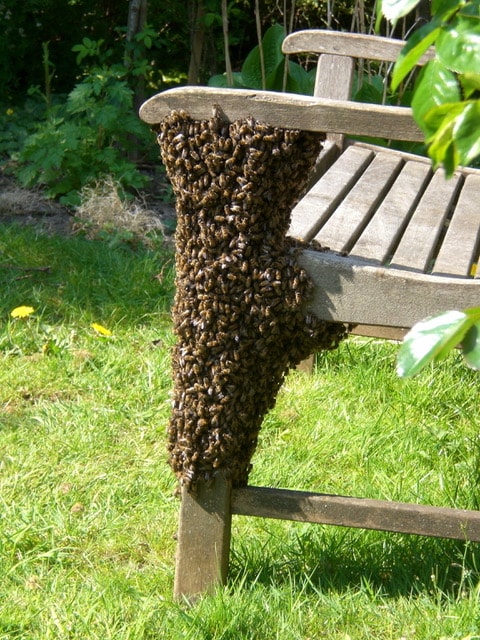
Here's the counterintuitive part: a bad winter for colonies often produces a chaotic spring swarm season. Colonies that survived winter in weakened condition build up unevenly. Some recover quickly and swarm early. Others build slowly, then swarm late. The result is a longer, less predictable swarm season — which is exactly what Memphis has experienced in spring and early summer 2026.
We've also seen more colonies moving into structures than in previous years. Swarms that can't find a suitable natural cavity — a hollow tree, a gap in a rock face — will settle for whatever void is available, including your attic, your soffit, or the gap behind your brick veneer. Drought-stressed colonies are more likely to accept marginal locations.
What Homeowners Should Watch For
If you're seeing more bee activity around your home than usual this summer, take it seriously. Scout bees — small groups of bees investigating gaps and openings — are the early warning sign that a swarm is considering your home as a new address. If you see bees repeatedly entering and exiting a specific gap in your siding, soffit, or roofline, a colony is either already established or about to be.
The earlier you call, the simpler and less expensive the removal. A colony that's been in your wall for two weeks is a very different job than one that's been there for two years. Call Bees Knees Apiary at (901) 825-0232 — we'll tell you exactly what you're dealing with.